Comforters · Materials & Construction
How to Evaluate a Duvet Insert: Fill, Shell, and Baffle Design
A duvet insert is a quiet collaboration between material and making. Its fill supplies insulation; its shell contains that fill while shaping the way air and moisture move; its construction determines whether warmth stays evenly spread or migrates, with patient inevitability, to the corners.
Published October 13, 2026
Shopping for a duvet insert can feel like learning a language whose nouns are familiar but whose adjectives are not. Down, cotton, baffle, fill power: each term seems to promise a simple answer. Is it warm? Is it light? Will it last? Yet the best answer rarely sits on a label by itself. An insert is a small system, and its performance depends on how the materials and construction work together.
That is true of ordinary goose-down bedding, down alternatives, and the rarefied category of eider down. The right comparison begins not with a ranking of luxurious-sounding fills, but with questions about use: What is the room like at night? Do you sleep warm or cool? Will the duvet serve as a single layer, or will it join a changing arrangement of blankets? How much care are you realistically willing to give it?
Once those questions are in view, the details become less mysterious. Fill affects warmth, loft, and weight. The shell affects breathability, containment, and feel. Baffle and stitch patterns influence how fill is held in place. Care instructions and sourcing information help reveal what ownership will actually involve. None of these elements is a footnote.
Begin with the job the duvet must do
A duvet insert is not a thermostat, although product descriptions sometimes make it sound like one. It provides an insulating layer; the warmth you experience also depends on the room, your sleepwear, the cover, the mattress, and your own response to heat. A winter-weight insert that feels welcome in a chilly bedroom may feel oppressive in a well-heated one. A light insert may be perfect in summer, or insufficient in a drafty house in November.
Think first in terms of the conditions you can describe. Is the bedroom consistently cool, or does its temperature swing with the season? Do you prefer a close, substantial layer, or the sensation of a covering that seems barely there? Is your habit to sleep under one duvet all year, or to add a blanket when the weather turns? These practical observations are more useful than the broad promise of “all-season” comfort, a phrase that can describe a genuine middle weight or simply avoid naming a specific climate.
Warmth labels are not always standardized between makers. “Lightweight,” “summer,” “year-round,” and “winter” are useful within a particular range, but they do not guarantee that two products carrying the same label will feel alike. Compare the construction, fill amount, and stated intended use, and ask the maker for more detail if a warmth description leaves too much to the imagination.
Layering offers another way to think about the decision. Someone who changes bedding with the seasons may prefer a lighter insert that can be paired with a blanket. Someone who wants one dependable layer may find a midweight option more practical. Neither approach is inherently superior. The question is whether the insert’s warmth matches the habits and temperature of the household that will use it.
Fill: loft is not the whole story
The fill is the insulating heart of a duvet. Natural down consists of the soft clusters found beneath the outer feathers of birds. Its branching structure can trap air, creating warmth without requiring a dense, heavy layer. Feather blends contain more feather material and generally provide a different balance of structure, resilience, and softness. Down-alternative inserts use manufactured fibers, which vary in composition and feel; some are designed to imitate down’s loft, while others have a more uniform, quilt-like character.
Fill power is often presented as a direct measure of quality. More precisely, it describes the volume occupied by a given weight of down under a specified test. Higher fill power indicates greater loft per unit of weight, and can allow an insert to achieve substantial loft with less fill. It does not, by itself, tell you how warm an entire duvet will be. Fill quantity, dimensions, chamber design, and the maker’s warmth category all matter. A high number on a label is one piece of evidence, not a verdict.
For a useful comparison, look for both a fill-power figure, when applicable, and the actual fill weight or other information about the amount used. Two inserts may list similar fill power and still differ in warmth if they contain different quantities of fill or use different construction. Conversely, a lower fill-power product may be designed to provide ample warmth by using more fill. The specification needs its context.
Down blends and alternative fibers add further distinctions. A blend may combine down with feathers to create a feel that is less cloudlike and more substantial. A synthetic fill may appeal to someone who prefers to avoid animal-derived materials, wants a machine-washable option, or has particular sensitivities. These are individual priorities, not universal rules about which material sleeps cooler or lasts longer. Construction and care can make a meaningful difference to either category.
One example of a down alternative is the DownTown Company Alpine Down Alternative Comforter, described with microfiber fill, a cotton cover, and baffle-box construction. It provides a point of comparison for readers considering a washable synthetic option rather than down. As with any specific insert, its stated care instructions, dimensions, and warmth should be checked against the needs of the bedroom.
Eider down: a distinctive material, not a shortcut
Eider down has an unusual place in the vocabulary of bedding. It comes from the down of the eider duck, a bird associated with northern coastal regions. Unlike the fluffy clusters commonly pictured when people think of goose down, eider down has a naturally interconnected structure. The clusters cling together, a property that helps them form a cohesive insulating mass. That distinctiveness contributes to the material’s reputation and makes careful sourcing especially important.
The name alone, however, cannot tell you what a particular duvet contains, how it was obtained, or what standards governed its handling. Ask for clear documentation of the source and the supply chain. Look for an explanation of how the down is collected and processed, and for any applicable certification or independent verification. If a seller uses terms such as “ethical,” “responsible,” or “sustainable,” seek the specific standard behind the claim rather than treating the adjective as proof.
Eider down is commonly associated with hand collection from nests after the birds have left them, but practices and descriptions should be verified for the actual product under consideration. Do not assume that a general account of the material’s traditional collection method necessarily documents the origin of a particular insert. Traceability is a property of the product’s information, not a quality that can be inferred from its name.
Because eider down is a specialty fill, the construction and care details deserve equal attention. A rare material cannot compensate for a shell that leaks, a chamber design poorly suited to the duvet’s dimensions, or care requirements that are impractical for its owner. Nor does rarity mean that the insert will suit every climate. Consider eider down alongside the same questions you would ask of any fill: What warmth is intended? What does the maker say about the amount and arrangement of the fill? How is the item cleaned? How will it be stored?
The shell: where air, touch, and containment meet
The shell is the fabric envelope around the fill. It has a deceptively difficult assignment: feel agreeable against the skin, allow the bedding system to breathe, and hold small clusters or fibers inside. A very tightly woven fabric may help contain fine fill, while a softer or more open weave can have a different hand and airflow. The precise result depends on the fiber, weave, finishing, and fabric weight—not on a single number printed beside the word “thread count.”
Cotton is widely used because it can be woven in many ways and has a familiar, breathable feel. Cotton sateen often has a smoother surface and a subtle sheen; cotton batiste can be light and fine; cambric is another closely woven cotton fabric used in bedding. These names describe types of fabric construction or finish, not a guarantee of comfort. Two cotton shells with similar labels can feel different, and the quality of the finished fabric matters more than a tally considered in isolation.
Lyocell and other cellulose-based fabrics may offer a smooth hand and moisture-management properties, depending on how the fabric is made. Silk shells can feel exceptionally fine but may bring more restrictive care instructions. A down-proof shell is engineered to help prevent fill from escaping, though the term should be understood as a description of intended performance rather than a promise that no fiber will ever emerge.
Thread count measures the number of threads in a specified area under a particular counting convention. It can help describe a fabric, but it does not independently measure softness, durability, or breathability. Very high thread-count claims may reflect counting methods that include multi-ply yarns. A more useful assessment considers the fabric’s material, weave, weight, finish, and the maker’s explanation of how it is intended to perform.
Read the shell specification as part of the whole design. If a duvet is intended for a cover, corner loops or ties can help secure it in place. If the insert will be used uncovered, surface feel and cleaning become more prominent considerations. A duvet cover also limits direct contact with skin oils and everyday soil, reducing the frequency with which the insert itself needs attention.
Baffles, sewn-through boxes, and the geography of warmth
Fill needs to stay distributed. Without some means of control, it can migrate through use, leaving thin areas where cold spots appear and dense patches elsewhere. Baffles and sewn-through construction are two ways to divide an insert into compartments and manage that movement. Their differences are small in appearance and large in effect.
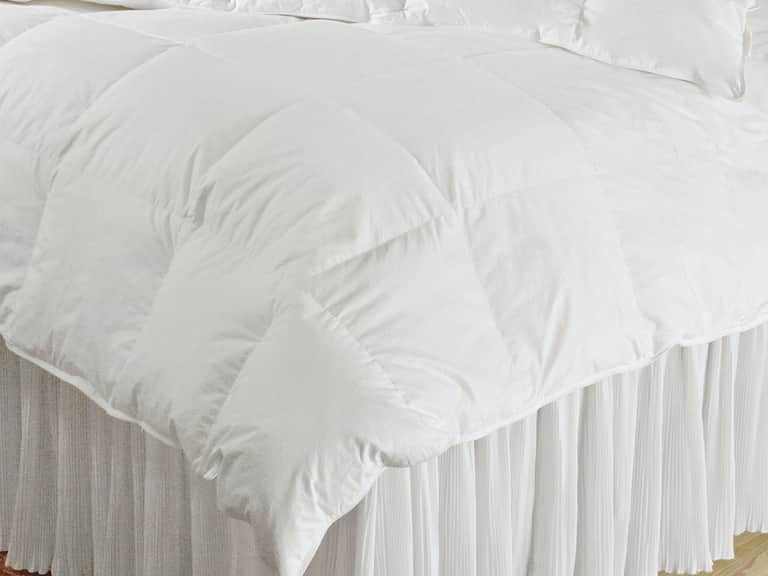
A baffle-box duvet has fabric walls between the upper and lower shell layers. These internal walls create three-dimensional chambers that allow the fill to rise into a box rather than being compressed at every seam. The added depth can support loft and help maintain more even distribution. Baffle-box construction is common in higher-loft down comforters, though the word “baffle” does not guarantee that every chamber is perfectly filled or that no shifting will occur.
In sewn-through construction, the upper and lower shell are stitched directly together along the compartment lines. This creates a flatter profile at the seams, where there is less insulation than in the filled sections. The result may be suitable for a lighter insert or a design intended to limit bulk. It can also help keep fill from moving too far. Whether the seams feel noticeable depends on the pattern, materials, and intended warmth.
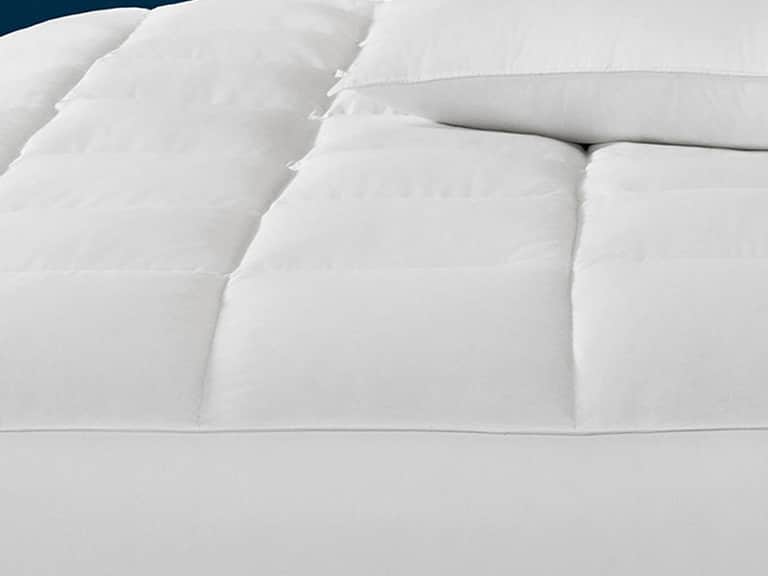
Box size and layout matter too. Large compartments can provide room for generous loft but may demand thoughtful fill distribution. Smaller compartments can help restrain movement, though they introduce more seam lines. Look for consistent quilting, secure edge finishing, and clear information about the construction. A product listing that says “box design” without explaining whether it is baffled or sewn through gives only part of the picture.
Consider the insert’s relationship with its cover. Corner loops or ties attach to the cover’s internal ties and help prevent the duvet from gathering at one end. This detail does not affect the fill’s intrinsic warmth, but it can improve how evenly the duvet lies on the bed. A beautifully lofted insert that has migrated into an awkward heap is not, in practice, performing at its best.
Care is part of the design
Care instructions are not administrative debris at the bottom of a product page. They describe the conditions under which the maker expects the insert to remain usable. Some down and down-alternative products can be washed in a suitable large front-loading machine; others require professional cleaning or spot treatment. Silk shells and specialty fills may carry more restrictive requirements. The label and manufacturer’s guidance take precedence over general advice.
When washing is permitted, size matters. A duvet needs room to move and rinse, and its fill must be dried thoroughly. Residual moisture can leave clumps and unpleasant odors; high heat may damage materials. Do not assume that a home machine is large enough simply because the duvet can be pushed inside it. Check the manufacturer’s directions before washing, and use a professional cleaner when the product calls for it.
Everyday habits can reduce the need for a full cleaning. A washable duvet cover acts as a barrier against soil, while regular airing in a dry, shaded, well-ventilated place can refresh bedding. Follow specific instructions about sunlight, handling, and frequency. For storage, choose a breathable fabric bag or other storage method recommended by the maker. Sealing natural fill in plastic for long periods can trap moisture.
Before buying, ask yourself whether the care routine suits your home. An insert that must be professionally cleaned may be an excellent choice for someone who accepts that arrangement and a poor one for someone who wants to wash bedding at home. Ease of care is not a minor convenience; it shapes how often an item can be refreshed and how confidently it can be used.
A practical comparison checklist
When several duvet inserts seem plausible, compare them on the same set of questions. This prevents the most prominent marketing claim—often a fill-power number, a certification, or an attractive fabric description—from crowding out the details that matter just as much.
- Fill: Is it down, feather-and-down, or an alternative fiber? Is the composition specified, and is fill power provided where relevant?
- Warmth: What weight or climate is the insert designed for? Does the stated guidance make sense for your room and layering habits?
- Shell: What fiber and weave are used? Is the description specific enough to assess feel, containment, and care?
- Construction: Is the insert baffled, sewn through, or otherwise compartmentalized? Are the dimensions and chamber details clear?
- Fit: Are the insert dimensions compatible with your duvet cover? Are there corner loops or ties to keep it aligned?
- Care: Can it be cleaned at home, spot-treated, or only professionally cleaned? Can it be dried thoroughly using the recommended method?
- Sourcing: Are origin and animal-welfare claims documented? For specialty materials such as eider down, is the specific source traceable?
- Durability: Does the maker explain construction, repair, warranty terms, or other details that help you understand the product’s expected life?
Comparing products on these points also makes it easier to distinguish a material’s properties from a maker’s design decisions. “Down” does not tell you the warmth level. “Cotton” does not tell you the shell’s exact feel. “Baffle box” does not tell you the compartment dimensions, and “responsibly sourced” needs supporting information. A good product description should make those distinctions clearer, not ask you to supply them from imagination.
The decision is a small act of matching
The most satisfying duvet insert is rarely the one with the longest list of impressive specifications. It is the one whose fill, shell, construction, warmth, and care requirements suit the life it will enter. For one household that may mean a lofty down insert with baffled chambers and a dependable cover. For another, a washable down alternative may make more sense. A specialty material such as eider down calls for particular attention to provenance, but the ordinary principles of comparison still apply.
There is a useful restraint in this approach. Instead of asking whether an insert is the best, ask what it is best suited to do. Instead of allowing a single number to stand in for performance, look at the full arrangement: material, quantity, fabric, stitching, and maintenance. These are not glamorous questions, but bedding is an intimate, repetitive object. Its virtues are tested not in a showroom but on an unremarkable Tuesday night.
When the details align, warmth feels even, the cover stays in place, and the care routine remains manageable. The result need not announce itself. A good duvet often makes its case by disappearing into the simple, welcome fact that the bed is comfortable.