Materials, sourcing, and care
Inside a Rare Nest-Harvested Comforter Fill: Sourcing, Warmth, and Care
Eiderdown begins not in a barn or a factory, but in the brief domestic architecture of a wild bird’s nest. It is collected in small quantities, prized for its unusual warmth, and inseparable from the places and rules that make its gathering possible. Understanding the material means looking beyond the bed: toward the bird, the landscape, the harvest, and the quiet responsibilities that follow.
A material with a particular beginning
Most comforter filling has a comparatively legible origin story. Down and feathers may come from waterfowl raised in agricultural systems; wool is shorn from sheep; cotton is harvested from a crop. Eiderdown follows a less ordinary route. It is the soft, fine down that female eider ducks use to line their nests, plucking it from their own breasts as they prepare a sheltered place for eggs. Once the nesting season has passed and the birds have left, people may gather the down from nests under locally established rules.
That last detail matters. Nest-harvested eiderdown is not simply another name for down from a farmed duck, nor does the phrase mean that every product marketed as “eider” has been gathered from wild nests. The words on a label can evoke a method without proving it. A careful account should distinguish the species, the location, the collection practice, and the chain of custody. Without those particulars, “rare” and “natural” are atmosphere, not evidence.
The eider duck is a sea duck of northern waters. In some coastal communities, the relationship between nesting birds and people has been maintained over generations: people provide or protect nesting places, monitor colonies, and collect down after nesting. Such arrangements are place-specific, not a universal custom or a licence to gather material wherever a nest is found. Conservation rules, land access, and local practice determine what can be collected, by whom, and when.
For a reader encountering the term on a comforter, this context is the first useful thing to know. The material is rare in part because the harvest is inherently limited. It cannot be scaled in the same way as a large poultry supply chain, and it depends on the continuing health of wild bird populations and their habitat. Scarcity here is not merely a luxury signal. It is a constraint that should invite scrutiny.
Why the structure holds warmth
Down is not a feather in the familiar, flat sense. It is a three-dimensional cluster, with fine filaments branching from a central point. Those filaments can interlock loosely, creating spaces that hold still air. Since trapped air slows the movement of heat, a light mass of down can provide substantial insulation. The principle is simple; the way a particular fill performs depends on several details, including cluster structure, cleanliness, distribution, and the textile construction surrounding it.
Eiderdown is valued for a particularly cohesive, soft structure. Its fine filaments can cling together, helping the fill form a resilient, airy layer rather than behaving as a collection of separate, slippery fragments. That characteristic is often described as interlocking. It helps explain why the material may stay in place and form a warm insulating layer with relatively little weight. It does not mean that every eiderdown comforter will feel identical, or that the material can compensate for poor construction.
Comforter warmth is a system, not a single number. The quantity of fill, the size and arrangement of chambers, the shell fabric, the dimensions of the comforter, and the temperature of the room all contribute. A generously filled comforter with an open, breathable shell may feel different from a closely quilted one containing the same kind of down. The sleeper matters, too: two people in the same room can disagree about whether a layer is pleasantly warm or uncomfortably heavy.
Terms such as fill power are useful, but they should not be treated as a complete ranking of comforters. Fill power describes the loft of a given quantity of down under specified testing conditions; it can help compare down products, but does not by itself establish warmth, ethical sourcing, or overall quality. Eiderdown’s distinctive character is often discussed in terms of its fine, cohesive clusters and the exceptional insulation they can provide for their weight. Buyers should still ask what the stated measurements mean and how the finished comforter is constructed.
Nor is the most insulating fill automatically the best choice. A warm bedroom, a naturally warm sleeper, or a household that prefers seasonal layering may call for a lighter comforter. A colder room can make a higher-warmth option attractive. The sensible aim is not to acquire the rarest material available, but to find a balance between warmth, breathability, weight, maintenance, and the realities of daily use.
The ethics are in the process
Nest harvesting is sometimes presented as inherently benign because the material is gathered after the birds have finished nesting. The timing can be an important safeguard, but a responsible account should not stop there. Ethical provenance involves the whole practice: how nests are monitored, how collectors avoid disturbance, whether gathering is permitted in that place, how much material is removed, and how the origin is documented as the fill moves through processing and manufacture.
Local rules differ, and a practice that is lawful in one setting may be prohibited in another. Wild birds and their nesting areas can be subject to conservation protections; habitat conditions and population pressures also change. A responsible collector follows the relevant rules and respects the limits they establish. A responsible seller should be able to explain the origin of the fill without asking a customer to accept a vague appeal to tradition as proof.
Traceability can be complicated. Down is cleaned, sorted, blended, transported, and placed into a finished article, sometimes through several stages and locations. Each step makes clear records more valuable. Look for information identifying the species and harvest region, describing the collection method, and explaining how the material is tracked through processing. If the product is certified or subject to an independent audit, ask what the scheme actually covers. A certification may address animal welfare or supply-chain controls without resolving every question about ecology, labour, or local stewardship.
It is equally reasonable to ask what is not being claimed. Does the seller specify that the fill is genuine nest-harvested eiderdown, or does the description use “eider” as a general mood? Does the information distinguish a wild-nest harvest from down obtained through conventional poultry production? Can the seller name the relevant jurisdiction and describe how the harvest complies with its rules? Plain, verifiable answers are more useful than a parade of adjectives.
Rarity can make the material attractive to collectors and luxury buyers, but it can also encourage imitation and imprecise language. A high price is not proof of ethical sourcing; an old-fashioned story is not a substitute for records. When the origin is unclear, a buyer should be free to pause. There are many other materials with strong insulating performance, and choosing one with better-documented provenance is a practical decision, not a failure to appreciate craft.
How it compares with familiar comforter fills
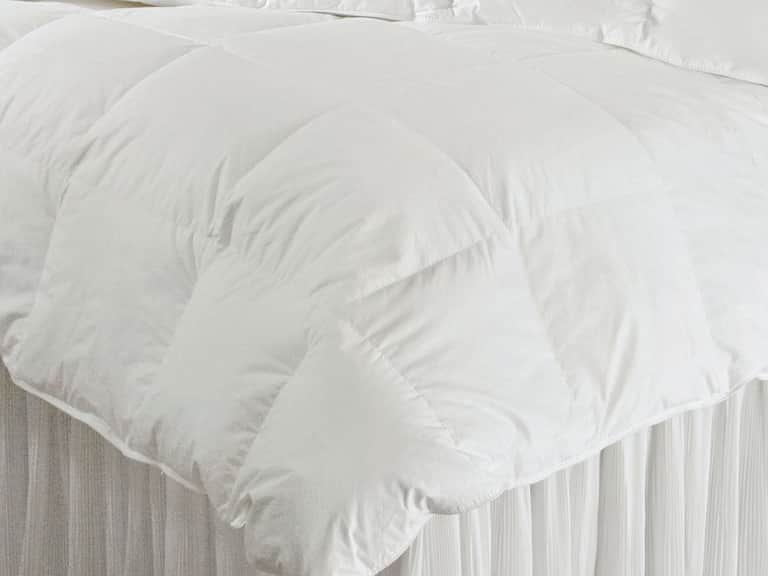
For contrast, consider an ordinary down comforter. Its insulation also comes from the airy structure of down clusters, but its source and supply chain may be quite different from those of a nest-harvested fill. Products may use goose or duck down, sometimes mixed with feathers, and their performance depends on the proportion and quality of those components as well as their construction. A product description such as the Downtown Company Villa Goose Down Comforter, for example, identifies European white down, a cotton shell, and box construction. Those details help describe a conventional down comforter; they do not make it nest-harvested eiderdown.
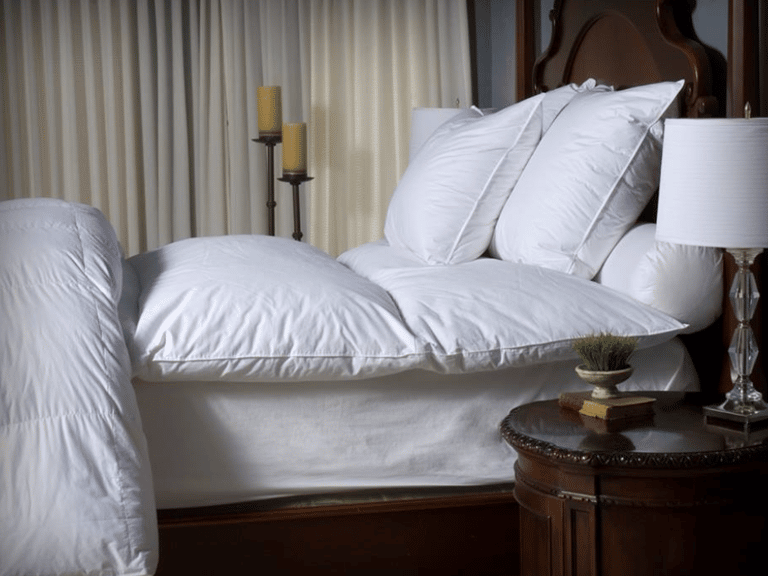
Feather-rich fills tend to have a different character. Feathers have a central shaft and can provide more structure and weight than down clusters. A structured featherbed, such as the classic featherbed with a three-chamber construction, is designed around a feather-dominant fill. That kind of product serves a different role from a lofty comforter, and the comparison is useful chiefly because it shows how fill composition changes feel and support.
Down alternatives may use recycled polyester, other synthetic fibers, or plant- or wood-derived fibers. They can suit people who avoid animal-derived filling, value familiar washing routines, or prefer a product whose supply chain is more straightforward to evaluate. They may differ from down in compressibility, breathability, longevity, and how they respond to repeated laundering. There is no single best fill for every sleeper or household. The more informative question is what the material does, how it is made, and whether it fits the user’s needs.
These comparisons are not a contest in which rarity wins by default. A well-made, responsibly sourced conventional comforter may be the more practical choice for everyday use. A synthetic alternative may be preferable to someone who prioritizes animal-free materials. Nest-harvested eiderdown is a singular option for those drawn to its structure and provenance, but its unusual origin increases the importance of careful buying and care.
Questions worth asking before buying
A comforter label rarely tells the whole story, but a focused set of questions can make an opaque product easier to assess. The goal is not to demand an elaborate dossier from every retailer; it is to distinguish specific information from decorative language.
- What exactly is the fill? Ask whether it is genuine eiderdown gathered from wild nests, another type of down, feathers, or a blend.
- Where was it collected? A named region or jurisdiction is more useful than a broad reference to northern heritage.
- How was the harvest managed? Look for an explanation of timing, permissions, safeguards for nesting birds, and any applicable conservation rules.
- How is the material traced? Ask how identity and origin are maintained through cleaning, processing, transport, and manufacture.
- What does an assurance or certification cover? Confirm whether it relates to animal welfare, supply-chain traceability, chemical testing, or another defined area.
- What is inside the finished comforter? Seek the fill composition, fill weight if available, shell material, construction details, and warmth options.
- What happens if it needs repair or cleaning? A care plan is part of the product’s practical value, especially when the fill is delicate and expensive to replace.
A seller who can answer these questions clearly may be able to point to records or explain the limits of available documentation. Uncertainty is not automatically evidence of wrongdoing; supply chains can be complicated. But a confident claim of ethical provenance should be supported by more than confidence.
Care for a delicate fill
Good care begins with prevention. A duvet cover shields a comforter from body oils, perspiration, household dust, and the small accidents that accumulate over time. Washing the cover regularly is usually simpler than laundering the filled article. A breathable cover also allows the comforter to be used as intended without treating it as an exposed surface that must be cleaned after every mishap.
Fluffing the comforter gently can help restore its loft and distribute the fill. Avoid vigorous shaking or twisting, which can stress seams and delicate clusters. When airing it, choose a dry, shaded, well-ventilated place rather than leaving it in strong, direct sun for long periods. Dampness is a more serious concern than a little softness lost in ordinary use: moisture trapped in fill can lead to odour, clumping, and, if the article is stored before it is fully dry, mould.
Do not assume that machine washing is safe simply because a washing machine has a gentle cycle. The care label and the maker’s guidance should determine what happens next. A delicate, high-value fill may need a specialist cleaner experienced with down-filled articles. Before handing it over, ask whether the cleaner understands the material, how it will be dried, and how the finished comforter will be checked for residual moisture or uneven distribution. Home washing, when unsuitable, can put both the fill and the stitching at risk.
Small spots may be dealt with locally if the manufacturer permits it. Use a restrained amount of appropriate cleaner, avoid saturating a wide area, and ensure that the affected section dries completely. For major spills, persistent odours, or any sign of moisture damage, professional advice is prudent. An elaborate wash routine is not necessarily a sign of superior care; unnecessary washing itself can shorten the life of delicate bedding.
Storage deserves the same attention. Clean the comforter only when needed, allow it to dry thoroughly, and store it in a clean, breathable fabric bag in a dry place. Avoid compressing it tightly for long periods, and avoid sealed plastic storage if moisture could be trapped inside. A duvet that has been packed away damp may emerge with a problem that airing cannot solve.
Keep the label and any care documentation. If a warranty or repair service depends on the article’s identification, removing the label can complicate a future claim. More broadly, documentation preserves practical knowledge: what the fill is, how it was assembled, and what its maker recommends when ordinary household care is no longer enough.
Rarity, value, and the life of an object
The appeal of nest-harvested fill is partly physical: the lightness, the yielding loft, the sense that warmth can be held in a surprisingly thin layer. It is partly historical, too. The material carries traces of a relationship between people and a wild landscape, though that story should be told with care rather than turned into a romantic certificate of virtue. A tradition can be meaningful and still require contemporary safeguards, records, and scrutiny.
In assessing value, consider the whole life of the comforter. A costly material kept clean with a cover, stored properly, and repaired when possible may remain useful for many years. But longevity should not be presumed from a luxury price or from language such as “heirloom.” Ask about the shell, stitching, construction, repair options, and the maker’s aftercare. If the product cannot be maintained or its origins cannot be explained, its rarity may be less compelling than its marketing suggests.
There is also a modest environmental lesson in the material’s limits. A wild harvest cannot be expanded indefinitely without regard to the conditions that sustain it. A responsible supply is defined not only by what can be gathered, but by what must remain undisturbed. In that sense, the absence of a limitless supply is not a defect to be engineered away. It is a reminder that some materials are valuable precisely because their sources are finite and their use must be proportionate.
A quieter kind of luxury
To choose a nest-harvested comforter is to choose more than warmth. It is to accept the need for questions: about species, season, place, permission, chain of custody, construction, and care. The answers may be satisfying, or they may reveal that another material is the wiser choice. Either outcome is part of making an informed decision.
The finest comforter is not necessarily the rarest one. It is the one whose warmth suits the room, whose construction suits the sleeper, whose origins can be described without evasion, and whose care the owner is prepared to provide. Eiderdown offers a striking example of how natural insulation can emerge from a delicate structure and a limited harvest. Its story is most persuasive when the bird and its habitat remain at the centre of it—not merely the softness waiting at the end of the supply chain.