Textile materials · Bedding
Wool Fill in Coyuchi Bedding: How Fiber Structure Shapes Comfort
Wool has a quiet talent for making a bed feel less like a sealed envelope and more like a small, well-ventilated landscape. Its fibers bend, spring back, and hold pockets of air; they also interact with moisture in ways that help explain wool’s distinctive reputation as a bedding fill. To understand what that means in practice—and what to examine when evaluating Coyuchi wool bedding—it helps to look closely at the fiber, then at the finished object wrapped around it.
A fiber with a little spring in it
Under a microscope, wool does not look like a smooth, straight thread. It has a naturally wavy form, usually described as crimp. The scale and frequency of that waviness differ with the animal, breed, and fiber preparation, but the general effect is familiar even without magnification: wool gives a little when pressed and tends to recover some of its shape afterward.
In a bedding fill, that structure matters because crimped fibers do not lie together as a flat, uniform mass. They create small spaces between and among themselves. Air occupies those spaces, and still air is a useful insulator. The result is a material that can provide warmth without depending solely on dense, heavy packing. The fiber’s spring also contributes to loft—the thickness or volume a filling maintains—though the performance of any particular comforter or pillow depends on more than fiber shape alone.
It is tempting to make a single grand claim for wool: that it is warm, breathable, and just right for everyone. Materials rarely behave so conveniently. A wool fill’s feel is influenced by fiber length and fineness, how the fibers are cleaned and prepared, the amount used, the way it is held in place, and the fabric enclosure. A thin layer of one wool batting may feel quite different from a generously filled comforter. “Wool” is a useful beginning, not a complete specification.
That distinction is especially useful when reading bedding descriptions. A product name or a photograph can suggest softness, but neither tells a reader how the fill is structured. Construction details—batting, loose fill, stitched channels, tufting, or an adjustable inner case—give a better sense of how a product may behave over time.
Warmth, without the sealed-up feeling
Wool’s reputation for warmth begins with those pockets of air. The material helps slow the movement of heat away from the body, while its structure can allow air and water vapor to move through the textile. This combination is often described as breathability. It does not mean that wool actively cools a sleeper or guarantees a constant temperature. Rather, the fill may feel less clammy than a material that traps warmth and moisture in a less permeable arrangement.
Sleep warmth is a negotiation among the sleeper, the room, the layers, and the bedding itself. A wool comforter in a cool bedroom may feel reassuring; the same weight in a warm room may be too much for someone who runs hot. Nightwear, mattress protectors, sheets, humidity, and personal preference all enter the calculation. The fiber contributes to the experience, but it does not govern it.
Wool also interacts with moisture. Its fiber structure can absorb water vapor into the fiber while the bedding still feels relatively dry to the touch. That is different from liquid water, and it should not be taken to mean that wool is waterproof or can be left damp without consequence. If a comforter becomes wet, it still needs to be dried thoroughly and according to its care instructions. The point is subtler: in ordinary use, wool’s relationship with vapor may help moderate the humid sensation that sometimes develops under bedding.
Descriptions that use words such as “temperature regulating” are often trying to summarize this combination of insulation and moisture handling. It is a helpful shorthand, but not a personal promise. The best measure is the product’s specified weight and construction, considered alongside the room in which it will be used and the sleeper’s own habits.
The fill is only part of the story
When considering Coyuchi wool bedding—or any wool-filled bedding—the next question is not simply how much wool it contains. It is how the wool has been made into a usable layer. Batting is a sheet-like form of fiber, while loose fill may be distributed within a case or divided into sections. These forms can create different sensations: a continuous, gently cushioned surface in one case, a more adjustable or resilient fill in another.
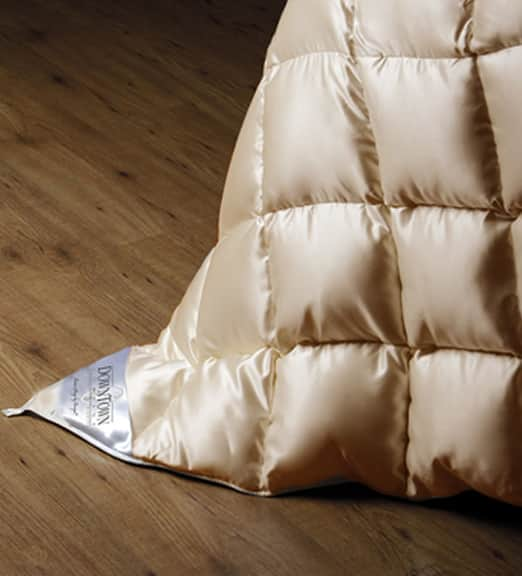
Construction controls movement. Stitching, quilting, tufting, and channel designs hold material in position, but each method leaves its own signature. A quilted grid can limit the distance fill travels; a tufted wool comforter may use ties or stitches to anchor batting without compressing every part of the surface equally. A zippered pillow case, if present, may permit the user to add or remove fill. These are not decorative footnotes. They influence whether a bed layer stays even, how readily it can be adjusted, and what sort of care it requires.
Shell fabric matters, too. Cotton is common in bedding because it is familiar, washable in many constructions, and available in different weaves and weights. A tightly woven shell can help contain fibers; a softer, lighter fabric may give the bedding a more relaxed hand. Fiber content alone cannot tell you how a cover will feel against the skin. Weave, finishing, thread characteristics, and the weight of the cloth all count.
For that reason, a close reading of a product description should separate the materials from the marketing language. Look for the fill composition, shell fiber, construction method, weight or warmth category, dimensions, country of origin where disclosed, and specific care directions. If a listing offers only broad claims—“natural,” “luxurious,” “all-season”—it leaves important questions unanswered.
What to look for in Coyuchi wool bedding
Brand recognition can make a search feel easier, but it should not replace examining the object. Coyuchi is a name associated with bedding and home textiles; the details of a particular wool item still need to be assessed on their own. Product lines change, specifications may differ between models, and a brand’s general material philosophy does not necessarily describe every component of every product.
Start with the fill. Is it wool batting, wool puffs, or another form? Is the wool described as organic, locally sourced, or traceable? Such terms can be meaningful, but readers should look for the scope behind them. “Organic” may refer to a particular fiber or processing standard rather than every part of a finished article. “Locally sourced” is useful only when the location and supply-chain context are clear. A precise description is more informative than a cluster of reassuring adjectives.
Next, consider whether the filling is fixed or adjustable. A fixed-fill comforter is designed to keep its intended thickness; an adjustable pillow can be tailored by removing or adding material, provided its construction allows access. That flexibility may be valuable for someone whose preferred pillow height is difficult to find. It also means the owner must be willing to handle the fill and follow the maker’s instructions when refreshing the pillow.
Finally, pay attention to the stated use. A wool comforter, mattress layer, and pillow do different jobs. Comforters are principally about coverage and warmth. A mattress pad affects the surface beneath the sleeper. A pillow has to balance compressibility and support, and the relevant variables include shape, fill quantity, and the sleeper’s position. A material can be appealing in one of these roles and less suitable in another.
Wool, down, and synthetic fills: not a contest
Comparisons among bedding fills are most useful when they describe differences rather than declare a winner. Down clusters are light and highly compressible, trapping air in a three-dimensional structure. Depending on quality and construction, down bedding can feel exceptionally lofty for its weight. Wool has a different character: its crimp and resilience support a more substantial, springy feel, while its moisture interaction is often part of its appeal.
Synthetic fills vary widely. Some are engineered to imitate the loft of down, and many can be easier to wash than delicate natural fillings, depending on the product label. Their feel, breathability, durability, and environmental profile depend on fiber type and construction. “Down alternative” is not one material but a broad category. Recycled polyester, for example, raises different sourcing questions from newly produced polyester, while a plant-derived cellulose fill has its own processing and care considerations.
Wool is not automatically the more sustainable choice simply because it is natural. Responsible evaluation may include animal welfare, land management, processing, transport, product lifespan, repairability, and what happens at the end of use. The same scrutiny belongs to down and synthetic materials. Certifications can help, but the reader should identify what each one covers: animal welfare, fiber content, chemical restrictions, or organic production are distinct matters.
There is also the matter of touch. Some people love wool’s gentle resilience; others prefer the cloudlike yielding of down or the easy maintenance of a washable synthetic comforter. A material guide can describe likely behavior, but it cannot substitute for an individual’s sensory judgment. When possible, examining the fabric and filling in person is worth the trip.
Care begins before the first wash
Natural fills are often durable, but durability is not immunity. The first and most important care instruction is the one on the product label. Wool bedding may be spot-clean only, professionally cleanable, washable in a particular way, or designed so that a removable shell can be laundered separately. These options are not interchangeable. A general internet rule should never overrule the maker’s directions for a specific construction.
Before washing anything, ask whether washing is necessary. A washable cover can take much of the routine soil, while regular airing may help bedding feel fresher between deeper cleans. If the product is designed to be aired, choose a dry day and avoid leaving it exposed to strong direct sun for an extended period. Airing is not a substitute for cleaning when a spill or soil requires it, but it can reduce the impulse to launder a large, difficult textile too often.
If a label permits washing, temperature, detergent, agitation, and drying all matter. Wool can felt or shrink under combinations of heat, moisture, and mechanical action; its response depends on how the fiber has been processed and finished. Use only the method specified. A bulky comforter also needs enough room to move and dry evenly. A crowded household machine may not be appropriate, even if a small wool item can safely be washed at home.
Drying deserves particular attention. Moisture left inside a thick fill can lead to odors or damage, while high heat may harm fibers or fabric. Follow the product’s instructions, allow adequate drying time, and do not store bedding until it is fully dry. For an item with a removable cover or adjustable fill, check whether each component has its own care requirements.
Between seasons, store wool bedding clean and dry in a breathable fabric bag or a similarly ventilated place. Avoid sealing a damp textile in plastic. Protect it from pests with appropriate storage practices, and inspect it before putting it away. A little routine attention can be less dramatic—and much cheaper—than trying to revive a neglected comforter later.
Questions worth asking before choosing
A bedding purchase can be approached like a small materials investigation. The questions below help move the discussion from vague impressions toward useful evidence:
- What is the fill, exactly? Look for wool type and form, rather than relying on a broad “natural fill” label.
- How is it held in place? Quilting, tufting, chambers, and removable cases each affect distribution and maintenance.
- What does the warmth description mean? Seek a stated weight, seasonal use, or other concrete guidance, then compare it with your bedroom conditions.
- Which part is certified? Check whether a certification applies to the wool, the shell, a process, or the finished product.
- Can it be cleaned at home? Read the exact care label and consider the capacity of your washer and dryer before assuming that it can.
- Can the item be repaired or adjusted? Replaceable covers, accessible fill, and clear repair policies may extend useful life.
These questions are not an attempt to turn bedtime into a laboratory exercise. They are a way to avoid expecting a single word—wool, cotton, organic, breathable—to carry more information than it actually does. A good description should let a reader understand the construction and its limitations, not merely imagine a pleasantly windswept pasture.
The useful distinction between a property and a promise
Wool’s crimped structure is a material property. Its tendency to create air pockets, its characteristic resilience, and its interaction with moisture help explain why wool appears in bedding across many climates and traditions. But comfort is an outcome shaped by the whole textile and the person using it. A fiber’s theoretical advantages cannot guarantee that a particular comforter will suit a particular sleeper.
This is where careful product information becomes part of comfort itself. A clear account of sourcing, fill construction, shell material, warmth, and care gives buyers a more realistic picture. For Coyuchi wool bedding, as for any brand, readers should distinguish verified product specifications from broad brand descriptions, and should recheck current labels because materials and designs can change.
There is something modestly satisfying about that kind of attention. A bed is intimate, but the materials in it are not mysterious. They are fibers with origins, structures, strengths, and weaknesses. Wool’s crimp gives it a particular way of holding air and meeting moisture; the craft of bedding turns that small, repeated wave into a layer of warmth. Understanding the transformation makes the choice less about atmosphere and more about fit—and leaves room for the most important test, which is how the bedding feels after the lights go out.